Tuesday, 16 June 2015

A Squatter's Castle

Ten years ago Trish and I came through Grafton on a driving holiday up from Sydney. At that stage I had read Squatter's Castle but done little other research on my family history in these parts. We figured that seeing as we were in the area we should take a drive up and see what could be seen of the house. We found our way to what we figured were the gates into the place but they were clearly pretty secure. It was obvious they were monitored by CCTV and while we were stopped on the roadside trying to see if we could get a glimpse of anything, a 4WD arrived quick smart and a pleasant young farm hand asked if he could help. I explained that an ancestor had built the place and I was wondering if I could have a look. "Not without permission", he said. I asked who I could get permission from and he told me the Myer family in Melbourne, so that put paid to that.
A view of the Big House at Yulgilbar in the late 19th century. The house was photographed and painted frequently over the years and if you google Yulgilbar Castle you will probably come up with a variety of images over the years.

This time I did a bit more preparation and about a year ago I established contact with the Yulgilbar archivist Sue Ibbott. Sue has been very helpful and arranged for us to join in with a group of Grafton seniors on a tour today. The Myer family are clearly interested in preserving and developing the property's history and have established archives and a museum in the cellars of the house. Once a month they have a tour of the gardens and the archive and such is the interest in the place that the tours are booked out a couple of years in advance.
In the early 20th century the Big House deteriorated to such an extent that when the Myer family came to renovate it, removing the upper storey seemed the best solution.
On a hill overlooking the Big House is a folly, where the ladies of the house used to go to sketch & do needlework. Here Trish who often eoans her own lack of a castle, does a little sketching.

As family, Sue also arranged for the house caretaker John Denny to take us on an extra tour down to the family cemetery (known as The Vault) and to the manager's house which is built over and around the original homestead. For the purposes of my trip, this homestead is of greater interest than the Big House because it was where Edward left from in 1854, the Big House not being built until after his return.
We put some wattle on Edward's grave because I figured it might've been a while since he'd had flowers. The headstone to  the left rear is Mary Tindal, my Grans mother. Immediately behind Edward is his brother Fred and to his right, the smaller cross is a memorial to Theodosia. Behind her is their last child Hubert who died in infancy and in front of her are headstones for Mabel & Charles Lillingston. 


A painting done by Edward's sister Ellen in 1852 of the original Yulgilbar homestead. My mother found a print of this painting in an op shop in the 1970's and bought it for me, which was really when Yulgilbar first entered my consciousness. 
Trish & I in front of the old homestead. Somewhere under this building is the original cottage which over the years has been built over and around.

While Edward had hopes that Yulgilbar would become a dynastic family property (in fact it was in great part due to his complex will, leaving the place to his daughter Mabel Lillingston & her husband -with the proviso that future inheritors maintain the name of Ogilvie, which never happened - that it ended up being sold out of the family) I think that he would be reasonably pleased to see it today. While it hasn't become the Ogilvie country seat, it has become that for another dynasty, the Hordern-Baillieu-Myer family. They run it as a working cattle and horse stud and family retreat, which I think would please Edward as they have the resources to maintain both its agricultural and heritage values. In the 1930's the property passed into the hands of the family of Sam Hordern who for Albany readers, was the great nephew of Anthony Hordern who built the Perth to Albany railway, has his monument at the top of York St and is buried in the Albany cemetery.

Monday, 15 June 2015

A Complex Family Tree

The observant amongst you might have noticed John Travers Tindal's middle name and wondered where that came from so I thought I should give a brief explanation of my family tree.

I am Laurence Crispin Elder Travers. My father is Laurence John Travers who married my mother, Ailsa Berrie Elder. (As I go on, you will also notice that our family has often followed the Scottish tradition of using a mother's maiden name as a middle name.)

Dad's father was Laurence Erskine Travers. He grew up in Metung in the Gippsland and he married Phyllis Theodosia Grant Tindal. They were both living in England when they met. Laurence Erskine Travers father was Laurence John Travers (and his mother Blanche Erskine) who grew up in Hobart where his father Samuel Smith Travers had brought his family in the mid 19th century.

Samuel Smith Travers had a sister Anne Amory Travers who married Charles Grant Tindal of Ramornie Station. John Travers Tindal was their second son  and he married Mary Isabel Ogilvie, the oldest child of Edward David Stewart Ogilvie of Yulgilbar and they were parents of Phyllis T.G. Tindal.

Confused? So am I at times but what this means is that Phyllis and Laurence had grandparents who were siblings. What does that make them? Second cousins I think.

In those days you couldn't marry just anybody. You had to choose someone from a "good family" and I guess your own family was a good one. In colonial Australia there was an even more limited pool and a look at the Ogilvie family tree shows that many of his children married family friends and/or neighbours.

Anyway I guess that accounts for some of the strong genetic traits in the Travers family today, along with our uncanny ability at playing the banjo!

Friday, 12 June 2015

A Beautiful Valley

The last 2 days have been spent driving around the Clarence Valley and it is a beautiful place. In fact rather than trying to describe it in too many words, I'll let some pictures we took do the talking. Yesterday I wanted to check out canoe entry and exit points and the general canoeability of the river. We drove up on the North side through Copmanhurst and then to Lillydale where there is a bridge over to the South side. We then headed upstream to The Gorge and back to Jackadgery where I talked to the caravan park owner who has canoed much of the river. He reassured me that there were no hidden nasties where I wanted to go. From there we headed back into Grafton.
The river at Copmanhurst, just downstream from Ramornie Homestead on the far bank.
Old stock hut at Towgon Grange, just downstream from The Gorge.
The river at the bottom end of The Gorge.
Today we headed out to Ramornie Station that Great, Great Grandfather Charles Tindal bought in 1852 after having spent time working for Edward at Yulgilbar, as well as on other stations in the area. Like Edward, Charles went back to England in the mid 1850s and returned with a wife, Anne Amory Travers  (I'll explain our somewhat complicated family tree in a later post). On their return they built Ramornie Homestead in 1858 and it still stands today. My father's mother Phyllis Theodosia Grant Tindal lived there as a child before her family went to back to England. When she died Gran left me a small, childs chair which she said was made for her at Ramornie from local timber.

Ramornie Homestead 
If you want to know more about Charles Tindal, try this link to his entry in the Australian Dictionary of Biography adb.anu.edu.au/biography/tindal-charles-grant 1238
The stables at Ramornie, looking pretty much as they must have in the 1860s.
There is a number in the phone book for Ramornie Station and I'd tried it several times with no answer so we decided just to take pot luck. No one was home when we got there but I took the liberty of taking a number of pictures and left a note to say we'd called. The house looks to have a family living there with children's things around. It's in a fairly original state so gives a feel of what it once was.
Ramornie guest quarters.
Ramornie Meatworks on the Orara River from an album of photos of Grafton and surrounds held at the Mitchell Library. Charles was a patriarchal employer and built a village and school for his workers, adjoining the works. The album contains a number of other pictures of the works and village and can be viewed at acms.sl.nsw.gov.au


All that remains of the village at Ramornie Meatworks - the school bell post.
We then drove about 15kms back towards Grafton to the site of the Ramornie Meatworks that made Charles Tindal most of his money. We called into the house overlooking the site to see if they owned the land. A friendly older bloke, Don, did indeed own the land and when I explained my purpose was happy for us to take a poke around. Don said it was a "crying shame" what was happening with the Ramornie Homestead because he had heard it had been left empty and subject to vandalism. However, I was able to reassure him that isn't the case at present as it is clearly being lived in and looking ok.
Fig tree growing out of the Meatworks ruins.
From here to the trees in the background was once all Meatworks with the village up  onthe on the slopes to the rear left. Now just Don's cow paddock.

From the Meatworks we drove down to the Eatonsville Crossing. (Eatonsville Station was known locally as Eat'nswill in recognition of the bonhomie of it's owners.) This was the first point on the river where it could be crossed and given that it is about 80kms from the mouth, you can get some idea of how big this river is. While I say it was a crossing, it was notorious for people drowning in attempts to do so. Bear in mind that in the 19th century most Europeans couldn't swim so if they lost their footing or hold on their horse, that was it. (If horses can swim naturally, you'd think humans could!) Charles Tindal's younger brother was one of about 30 people to have drowned here and a cemetery was established on the north bank to bury many of them. In fact of 4 Tindal brothers, 2 drowned in ships off the Australian coast and a third here. Charles was the only one to survive! Hence my theory that it is a grand Australian tradition to drown trying to get here and that rather than trying to stop them, we should only allow migrants who arrive in leaky boats, on the basis that that is the kind of aspirational, can-do spirit that made this nation great!
The Eatonsville Crossing. Apparently its changed a bit in that bits were blown up so boats  could more easily pass through. Doesn't look too dangerous to a swimmer though. The cemetery is on the hill on the far bank.  

Monday, 8 June 2015

Thats Lawrence With a Double U, not Laurence With a U.

Yesterday we took a trip 30kms downriver from Grafton to the little village of Lawrence. The name of this town is not relevant to our family, despite our plethora of Laurences. Those Laurences are all from the Travers side of the family who were busy establishing themselves in Hobart at about the time the Ogilvies & Tindals were eyeing off the Clarence valley. Our Laurence is spelt with a u.

This Lawrence, originally called The Elbow, was named Lawrence in honour of a hero of the 1857 Indian Mutiny and earns its part in this story because of Edward Ogilvies attempts to make it the major centre on the Clarence, rather than Grafton. Apparently Edward didn't see eye to eye with the other patriachs of Grafton. Not sure why. Maybe he didn't like the idea of sharing his authority with others or perhaps he was just obstreperous. Whatever the reason, on his return from his trip to England he did his best to raise Lawrence's significance.
This watercolour is in an album by Edward Forde, held in the Mitchell Library. It shows the veranda of the Commercial Hotel in Lawrence in 1860, which was owned by Edward from about that time until it was delicensed in 1894. It burnt down many years ago according to the nice lady at the Lawrence Museum.

He bought land and property here and established a wharf from where he imported his supplies and exported produce from Yulgilbar, much to the chagrin of the Grafton merchants. He was backing the wrong horse, however, because Lawrence never really took off and once the railway went through Grafton in the late 1880s, that was it for Lawrence. 
All that remains of Edward's dreams for Lawrence. A park near where his wharf once stood.
Today it is a bucolic little hamlet with virtually no buildings of historic significance. Over the years flood or fire has claimed most of its older buildings, the Lawrence Hotel burning down as recently as 1987 (to be replaced by a modern tavern). To my eye the oldest building in town is probably the Police Station/House which I would guess to be c.1870s. There are a few others from the 1890s but mostly it is a tree change kind of place with modern houses on large blocks. On that basis it can give you a sense of what Grafton might have been in Edwards time, with houses scattered along the river on large blocks with vegetable gardens, fruit trees and the occasional horse or goat grazing in the yard. It also has a nice folk museum in a disused ABC radio station.
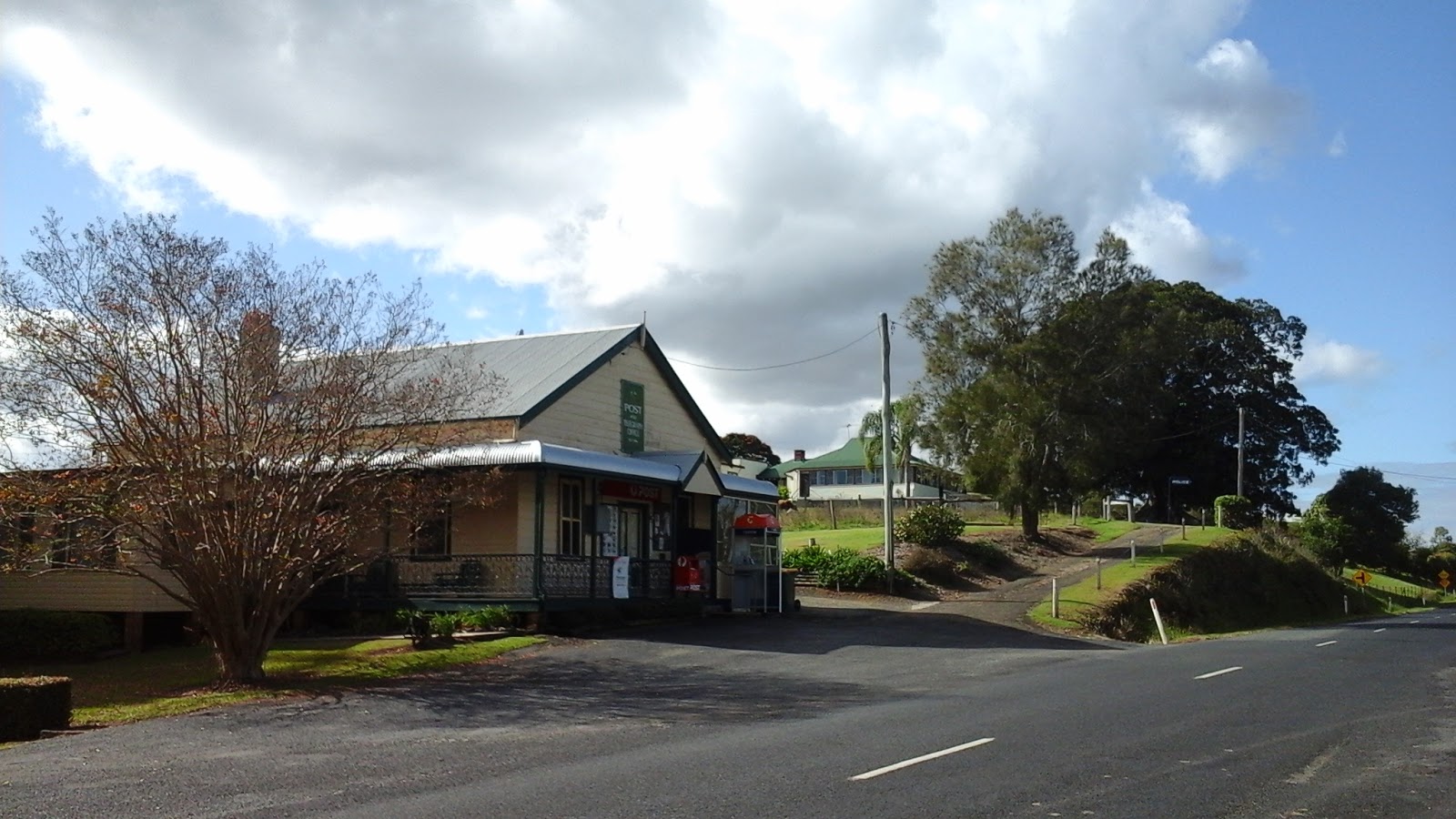
Lawrence Post Office with the Police Station in the background. The Commercial Hotel was up on the rise just past the Police Station.
From Lawrence we took a car ferry across the river down to McLean which is a town that has retained many of its historic pubs, shops and administrative buildings and has a nice feel to it. McLean is also the southernmost limit of sugar cane growing in Australia and it has a subtropical air with cane fields and macademia groves. From there we went down another 20kms to the mouth of the Clarence at Yamba.

Yamba is a sprawling beachside town that appears to have grown considerably in the last 40 or so years. Its like a lot of beachy places (think Mandurah) where the developers arrived before the planners. There are multi-storey apartment buildings, palatial beachside houses, the occasional old beach cottage, strips of takeaway food, surf shops, beach gift shops etc and then all the other joys of modern commercial life like Maccas, Target, Woolies etc. You know the drill. Perhaps Yamba is the aboriginal word for crass.
The mouth of the Clarence at Yamba. Two big stone breakwaters keep it open today.
The weather has been outstanding (sunny and low 20s) so today we packed a picnic and did a big bike ride up to the Rogan Bridge, the first bridge upstream from Grafton and a round trip of 52kms; a one day PB (personal best for those unsporty amongst you) for Trish. For me it was a good trial to see what the country is like for riding, as I intend doing the bits Edward rode horseback, by bike. While it is a bit up and down, the hills are not too steep so it should be a doddle.

Finally, when we got home we figured we should partake of some Ozzie culture not available to us in the West (praise the Lord); the pokie supported club (for a pokie supported cheap dinner). The nearest, & Grafton's flashest (reminded me of a mini Vegas casino) was the GDSC which I incorrectly guessed stood for Grafton District Sports Club. Wrong.  It's Grafton District Services  Club or in other words the RSL. We arrived a few minutes before 6pm and just afterwards a lady announced on the PA "Ladies & Gentlemen, its 6 o'clock". How thoughtful, I thought. As a contribution to responsible gambling they're letting all the addicts know that maybe they should go home for tea, or at least take a break.

But no. The PA lady went on to tell us all that it was time to stand, all face the west, and take a minutes silence while she recited the "Lest we Forget" verse and the whole place solemnly did! Do they do this every day in every  RSL? I never knew. Well at least that means they can't take the piss when Moslems do their daily prayers to Mecca.

Saturday, 6 June 2015

We Share Some History, This Town & I

Thus spoke Don Walker in his Cold Chisel song Flame Trees, which prior to me becoming interested in Edward, was pretty well the sum of my knowledge about Grafton. Walker spent time here as a child and wrote the song about his memories of the town. It's better known for it's jacaranda trees but I guess that didn't scan as well. (As a side note, I've long thought that Don Walker has not received sufficient acclaim in his role as the Banjo Patterson of the latter end of the 20th century. His lyrics are the bush poetry of those times, telling very Australian stories of ordinary lives. Well done Don.)
Gwydir Hwy at Heffron Lookout, overlooking Mann River a tributary of the Clarence.

We arrived here mid-week, driving down the incredibly scenic (it has world heritage listing apparently) Gwydir Hwy through the Gibralter Range & Washpool National Parks.

We're staying for the next month or so at the Gateway Caravan Park on the northern outskirts of town. Grafton is one of the most well treed places I've ever been with jacarandas, flame trees, huge Australian figs, palm trees and many more. There are also lush manicured gardens everywhere and this caravan park is no exception. Built around a central lillypond it's very reasonable at $22/night.
The lillypond at the Gateway Village. There's a telly in the gazebo where I froze last night watching Richmond destroy the Dockers hopes of 10 wins in a row!

Our "camp" at the Gateway. Bet it beats Edward's overnight camps.
It is also part park home park and I can only assume the price structure is to get the oldies in so they can be tempted by the joys of park living. With a swimming pool, tennis courts (don't even play tennis) and immaculate amenities block, kitchen, BBQ etc I'm tempted myself. Trish is currently off at Bingo in the recreation room so once she's addicted to that, we might move in. The only disconcerting note is the neat and politely worded signs around the place warning of "instant dismissal" (I think they mean eviction) for various offences against park policy. (I hope sarcastic blogging isn't one of those offences because I really do like the place.) Still it's given me a new lexicon and I now threaten Trish with "instant dismissal' if she does anything that annoys me.
An incredible avenue of fig trees in Breimba St, Grafton.
Grafton at just under 20,000 people is a little smaller than Albany but what it does share with us is an absence of traffic lights and a plethora of roundabouts in their place, plus no paid parking.  I could love the town for this alone. Perhaps we should develop a sister city relationship between the two places!

On arrival in town I visited the Clarence River Historical Society HQ and museum to start doing some local research. When I explained what I am doing I was very warmly received, being told several times "you're important". Made me feel like royalty.
Schaeffer House, c1900. 
We also visited the Grafton Regional Art Gallery because they currently have an exhibition of 1870's photo's by John William Lindt of Aboriginal residents of the Clarence Valley. The Gallery staff were also very helpful when I explained my project and have given me contact details of people in the local Original Australian community who may be able to help me locate stories about Ogilvie and Tindal and perhaps descendants of either.
Prentice House, c1880, a former Drs house bequeathed to the city to become its art gallery.
When Edward first arrived on the Clarence, Grafton was little more than a camp at South Grafton and it doesn't seem that there was much more when he left on his trip in 1854. I can only find a few buildings in town that pre-date 1860 at this stage. It did grow hugely during the years after his return although I gather that there was no love lost between him and the city fathers here. Edward favoured the town of Lawrence about 30kms downriver so I will visit there soon.

The Anglican Deanery & Parish Office which are about the only buildings I could find in town that pre-date 1860.

Tuesday, 2 June 2015

Our First Taste of Family

Inverell is an attractive town but I was keen to get to Glen Innes 70km further on where our first family connections begin. Inverell and Glen Innes both have attractive and well preserved late Victorian/Edwardian streetscapes and I'm starting to think I may have to rethink describing Stirling Tce as one of the best preserved examples of same. Perhaps best in WA.

We stayed at the Poplars Caravan Park in Glen Innes which I was moved to review on TripAdvisor as the best value in 5000kms because it is! Lovely spot despite the fact that it got down to -6C on our second night here (yes that's a minus sign) and the water in our van hose froze causing the hose coupling to pop open with the pressure.

Sorry. This photo should be below the one of the Tindal family but sometimes this blog has a mind of its own. It insisted it should be here! It's in the beautiful garden at Virginia/Tatiara.
I knew that dad's maternal grandfather, John Travers Tindal and his wife Mary, who was Edward Ogilvie's eldest daughter, had lived here just before John died in 1926, on a property called Tatiara. I inquired at the local historical society about the location of Tatiara and was told by the lady there that it was now called Virginia and she gave me the location. However, she said a family member is very unwell and said that while it should be ok to drive past, she asked me to not call in as it is a difficult time for them.
John, Mary & Dorothy Tindal in the gardens at Tatiara in 1922. Relatives & friends may be struck by John and Mary's resemblence to current family members! John was 62, only 2 years older than me when this was taken.

Again, this should be below the 1922 photo of the house but it didn't want to. It shows the same side as the older picture.
Virginia today, from the front. 
We went up there today and while I was taking some photos across the paddocks from the road, a charming lady named Rose, who was checking cattle on a quad bike, came across to ask what we were doing. When I explained, she said that it was her family property and that her sister Margaret,who lives in the old house is very interested in the property's history and probably would welcome a visit despite her husband's illness. She rang her to check and we were invited to come up.
Tatiara in 1922. Today the trees are much bigger obscuring this view but the house is little different (although lovingly preserved). Both these 1922 pictures are by photographer Michael Terry from a large collection of his in the National Library. 
Margaret proved just as charming as her sister and showed us around the house which was built in 1885. It's timber and iron with some magnificent polished cedar doors and paneling and many of the original ripple glass window panes. Her grandparents, Harold & Beatrice Mott bought it from the Tindals just before John died in 1926 and the Mott family have owned it ever since. The original Tatiara property was about 300 acres and the Motts also purchased the larger Virginia block over the road, combining both properties under that name.

After visiting Tatiara/Virginia, we took a circuit drive up to Emmaville which has a fascinating local museum, and then across to Deepwater which has another facility, essential to any good tourist destination, a great pie shop!

Monday, 1 June 2015

5000 kms From Home

Leaving Moree the land is still fairly flat but after about 50kms or so it starts to rise and become more heavily timbered. Just into the hills you come to Warialda which is notable for two things. Firstly the quality of the homemade Choc & Nut Biscuits sold by the lovely ladies at the Carinda House Cultural Centre (an old house in the centre of town that is also a museum and craft shop) and secondly the enthusiasm of the Visitor Centre staffer who came to town 27 years ago as a young teacher and never left.
Cranky Rock reserve, a lovely picnic spot just out of Warialda.
I mentioned to this lady that we had been to the Reconciliation Dinner in Moree the previous night and that prompted her to tell me that the Myall Creek Massacre wasn't far from Warialda. I had thought it was further south so hadn't been looking out for it but it was a place I wanted to visit. Without this lady's thoughtfulness we might have missed it.

Myall Creek is in a beautiful valley that belies its awful past. The massacre site has a short walk with interpretive signs telling the story of the massacre. It was an important event in that even in those days society was split into two types of people, those who believed we should get on with the Australians and those who thought the solution was to get rid of them. According to Squatter's Castle, the Ogilvie family were firmly in the former camp, Myall Creek split the colony open because a number of participants in the massacre were prosecuted and 7 hanged and there were those both for and against this prosecution. After that it seems that the will to prevent such incidents evaporated because there were few prosecutions of perpetrators of later massacres. The last recorded massacre took place in the Kimberleys in 1927, ten years after we waged war on Germany, in part because they were considered more barbaric than us!

I often think that Australia could be an even better place than it is, had the good guys persevered. The Barkers and Collies (and I hope - the Tindals, Ogilvies & Travers - more about that later). The ones who advocated entering into Aboriginal lands peacefully and politely, recognising their prior ownership and being prepared to gain some understanding of their culture and laws and work with that. For their part the Australians were usually quite affable towards polite visitors and welcomed them for their technology (look at Mokare)so had we been prepared to do it nicely, we could've been assimilated into the country and now reap the benefits of both cultures.

Sadly though we have often been dominated by the other mob. The ones who think that the best way to solve a problem is with arrogance and aggression. They're still at it today. (Incidentally, the last visitor in the book at Myall Creek before us was Barnaby Joyce, who had been there the previous day. Not drawing any conclusions mind you. Just saying.)

From Myall Creek we went on and spent the night at a campsite at Compton Dam which is probably lovely when it has some water in it. At the moment it doesn't really although it was still a nice spot. Next morning we headed into Inverell and a few kilometres short of there we ticked over 5000kms since leaving home.